Articles
Ethereum After Fusaka: Scaling a Neutral Settlement Layer
Richard Skeet
March 11, 2026
Ethereum’s long-term investment case does not rest on a single catalyst or wrapper. It rests on whether a decentralized settlement network can continue to scale without surrendering neutrality, auditability, or broad participation.
Q4 provided a useful real-world test of that proposition. In a quarter defined by volatility, deleveraging, and tighter liquidity, Ethereum delivered a major protocol upgrade on schedule. Fusaka activated on December 3, 2025, introducing PeerDAS data availability and related blob-capacity mechanics that expand Ethereum’s ability to support rollups at scale. This fits our broader framework, which holds that decentralization is not primarily an efficiency upgrade but a resilience upgrade, best understood as infrastructure insurance against concentrated technical and governance failures.
The core feature in Fusaka is PeerDAS, EIP-7594, which changes how Ethereum verifies rollup data availability. Historically, raising data throughput created a direct trade-off. If every node must download and store all rollup blob data, then scaling data capacity quickly raises hardware and bandwidth requirements and quietly shrinks the set of participants who can run full nodes. PeerDAS breaks that linkage by allowing nodes to verify blob availability - new chunks of blockchain data - through sampling rather than full download. In practice, Ethereum can increase rollup data capacity without proportionally increasing the cost of participation. That design choice is not incidental. Scaling is being pursued, but not by quietly increasing validator burdens and calling the result progress. The trade-offs are made explicit because hidden centralization is still centralization.
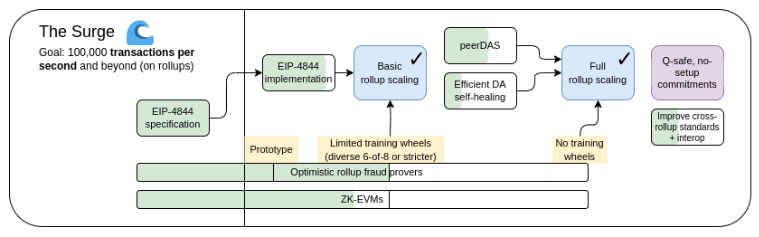
For investors, the significance is straightforward. Rollups now host a large share of Ethereum-based activity, including stablecoin settlement, tokenized assets, and on-chain trading. Their cost structure depends heavily on L1 data availability, pricing, and capacity. Expanding blob throughput and improving verification efficiency directly support lower and more predictable Layer-2 transaction costs over time. Multiple infrastructure and research groups describe Fusaka as laying the groundwork for multi-fold increases in effective rollup throughput as blob parameters are raised in controlled steps after the fork. This is Ethereum’s architectural compromise in action. Keep the base layer as neutral and verifiable as possible and let higher-speed execution happen at the edges through rollups rather than compressing everything into a faster but more centralized core.
Equally important is how Ethereum is approaching the economics of that expansion. Scaling supply without maintaining fee discipline risks undermining validator incentives and network security. Proposals such as EIP-7918 introduce reserve-style blob pricing mechanisms to prevent data availability from drifting toward structurally underpriced usage. In effect, scaling is paired with fee-market design so that network revenue and security budgets remain aligned as rollup demand grows.
There is also a noticeable operational shift in how Ethereum now scales. Rather than bundling every capacity increase into large multi-feature forks, the roadmap increasingly relies on parameter-only adjustments after major upgrades to raise limits in a controlled way. Blob parameter-only changes allow capacity to expand based on observed performance instead of optimistic projections. This is slower than the move-fast culture typical in software, but it is consistent with Ethereum’s core philosophy that neutral financial infrastructure should prioritize robustness over iteration speed. As we have written previously, decentralization behaves like insurance. It can look inefficient in quiet periods, but it proves its worth under stress. Doing hard engineering in public, under scrutiny, instead of optimizing for speed behind closed doors, is a feature of that model, not a bug.
Usability is improving alongside throughput. Account abstraction patterns and wallet standards such as EIP-4337 and EIP-7702 are steadily turning Ethereum accounts into programmable policy containers rather than simple key pairs. Capabilities such as delegated permissions, batched actions, spending limits, and gas sponsorship are becoming easier to express at the wallet layer. That matters for institutions and enterprises, where operational policy must be encoded rather than assumed. Circle and others have pointed to EIP-7702-style capabilities as enablers of gas-abstracted stablecoin transactions and smoother user flows. This is not just a user experience upgrade. It is a sovereignty upgrade that allows users and organizations to express transaction policy directly in code rather than relying on platform discretion.

Stepping back, Ethereum is not optimized to be the fastest chain. It is optimized to be a credibly neutral, widely verifiable settlement layer that can survive adversarial conditions. Neutrality, auditability, and broad participation are design constraints, not marketing slogans. They impose costs and complexity, but they also remove single points of control and failure. If the historical pendulum between centralization and decentralization continues to swing, infrastructure that preserves optionality and neutrality is likely to be repriced upward when trust in centralized intermediaries is again stressed.
--