Articles
Into the Collection: Dmitri Cherniak | Ringers (2021) & A slight lack of symmetry can cause so much pain (2021)
October 16, 2025
Dmitri Cherniak occupies a central position in the Digital Culture Fund’s collection. His practice bridges the analog traditions of Constructivism and Dada with the autonomy and emergence of on-chain algorithms. The following overview explores his most important bodies of work and highlights key acquisitions that reflect our belief in the long-term significance of generative art.
About the Artist: Dmitri Cherniak
Dmitri Cherniak (b. 1988) is an experienced software engineer and innovative generative artist based in New York City. He became involved with blockchain technology in 2014, and since then, has created several unique scripts that leverage the p5js and 3js libraries to produce generative art. In conversation with the Los Angeles County Museum of Art (LACMA), Cherniak defined himself as a “code-based generative artist,” stating: “Automation is my artistic medium.” He also described himself as a “technologist” who aims through his art to “push back on technology being used only as a political or economic lever.” In every project he undertakes, Cherniak seeks to highlight the autonomous nature of his artistic process. When he builds a generative program, Cherniak sets numerous parameters while intentionally leaving variables within the system that allow for chance, surprise, iteration, and experimentation.
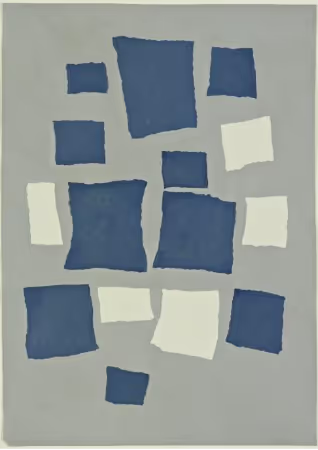
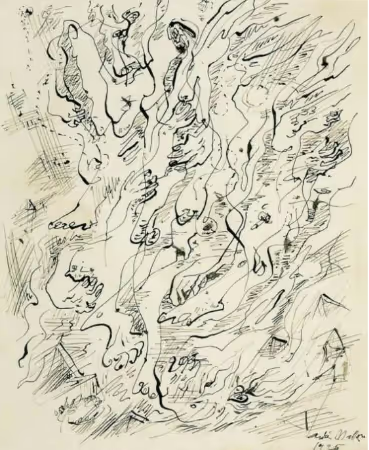
Although his background is in computer science and his artistic practice is focused on generative art, Cherniak’s work acknowledges the history of traditional art. His embrace of outputs from unmediated systems is a continuation of the autonomous and chance-based approach to artistic creation first championed by Dada artists in the 1910s and 1920s. These irreverent artists turned to operations of chance and spontaneity to subvert the conventions of order and logic that dictated modern society — a society that had just been devastated by World War I. For example, in 1916-17, the artist Jean (Hans) Arp famously dropped an assortment of variously sized colored paper squares on a sheet of paper, gluing them down wherever they landed to create a work of art (Figure 1). Shortly thereafter, Surrealist artists also embraced chance and spontaneity, but to a different end: to express the subconscious. One of the most popular examples of this was automatist drawing, in which Surrealist artists drew without consciously controlling their hand or lifting their hand from the paper (Figure 2).
About the Art: Ringers
Cherniak’s most celebrated and recognizable body of work to date is his Ringers collection, released on Art Blocks in 2021 as a series of 1,000 unique digital pieces. Ringers recalls the tactile games played by children or the serpentine belts used by engineers. It is executed in a limited palette of black, white, yellow, beige, and — far more rarely — blue, red, and green. Circles (or pegs) of varying sizes anchor the pieces and dictate the movement of lines (or string), which loop around the circles to create both solid forms and negative spaces. Cherniak has articulated that, whereas wrapping string around pegs on one’s hands in the physical world is a very intuitive and natural act, achieving the same visual effect digitally through code is complicated and “unnatural.” Nonetheless, the result appears familiar and organic.
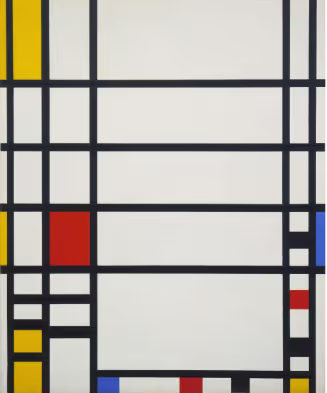
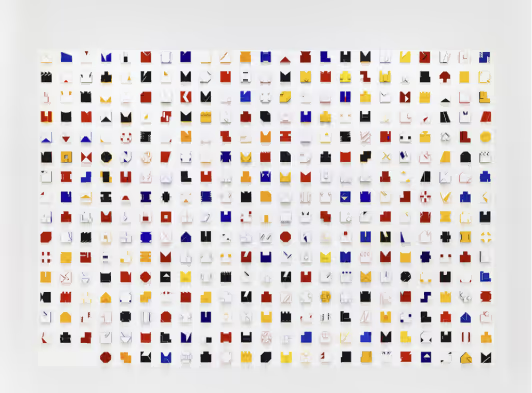
The dynamic geometry and primary colors are visually engaging and were influenced, in part, by the work of 20th century artists Piet Mondrian and Lygia Pape (Figures 3 and 4).
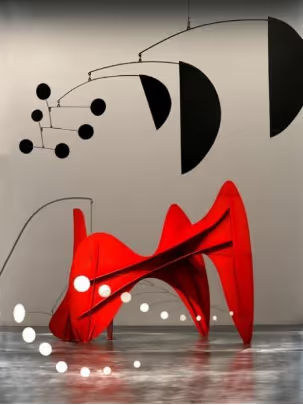
Despite being digitally native, Ringers also has a tactile, if not sculptural, quality that evokes the work of modernist sculptors like Henry Moore and Alexander Calder (Figures 5 and 6).

Cherniak has emphasized that Ringers is best understood not as 1,000 standalone works, but as a system. When viewed as a grid, patterns emerge — symmetry and chaos, repetition and anomaly — revealing the full shape of the algorithm’s logic.
In February of 2023, a piece from the Ringers series became one of the first on-chain works of art in the permanent collection of LACMA (Figure 7). It was the highlight of a group of 22 NFTs donated to the museum by the prolific collector Cozomo de’ Medici. Later that year, in June 2023, another piece from the Ringers series broke auction records: Ringers #879, nicknamed “The Goose” for the coincidental resemblance of its central form to the neck and head of a yellow-beaked bird (Figure 8), sold to Punk6529 during the Sotheby’s Grails auction for $6.2 million, more than doubling its high estimate.


Ringers marked one of the earliest moments in generative art where emergence — the unplanned significance of certain outputs — played a defining role in shaping community narratives. “The Goose” became an icon not through design but by chance, capturing the essence of generative art’s magic: when randomness produces a legendary symbol. In addition to statistically rare traits, several Ringers features have developed into community favorites — such as “Smol Bois,” whose small scale adds delicacy to the algorithm’s logic, or beige backgrounds, prized for their subtlety.
The Digital Culture Fund’s collection reflects both types of rarity: algorithmic edge cases and collector-beloved anomalies. We are proud to own 33 Ringers, including 5 pieces that previously resided in 3AC’s Starry Night collection alongside “The Goose”.
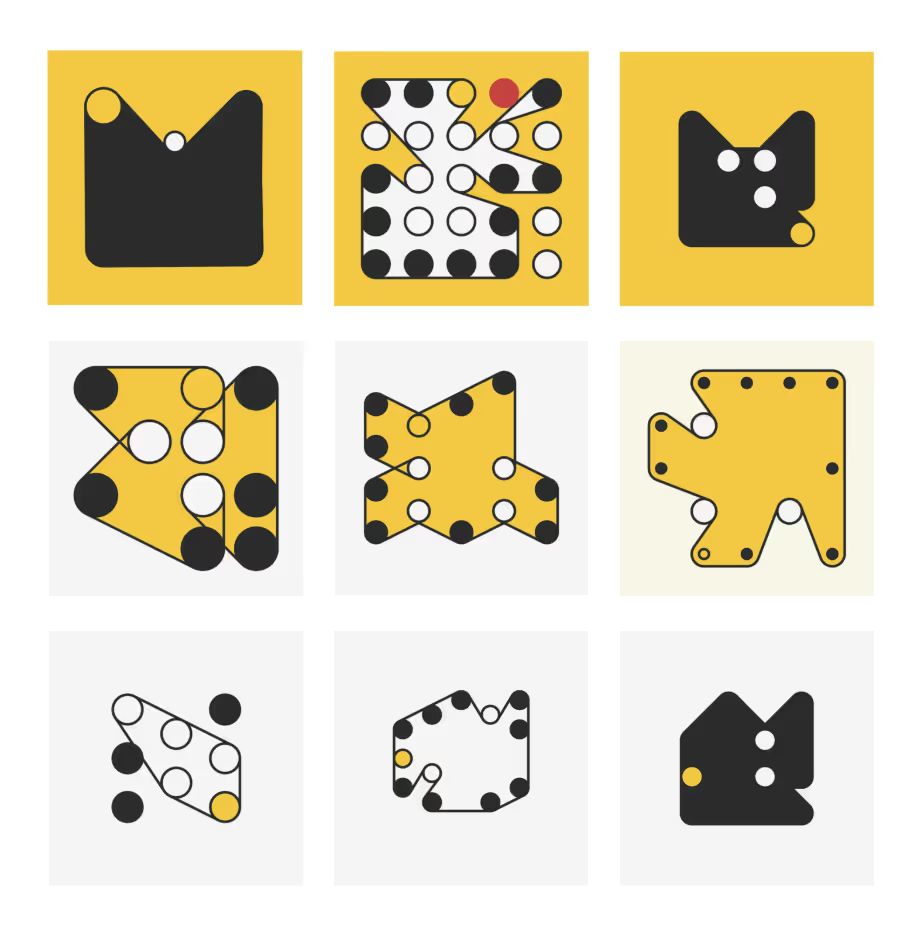
Four traits (Figures 9 and 10) have formed the cornerstone of the Digital Culture Fund’s Ringers collection:
Bullseye:
Yellow Background; Yellow Body; Smol Boi
About the Art: A slight lack of symmetry can cause so much pain
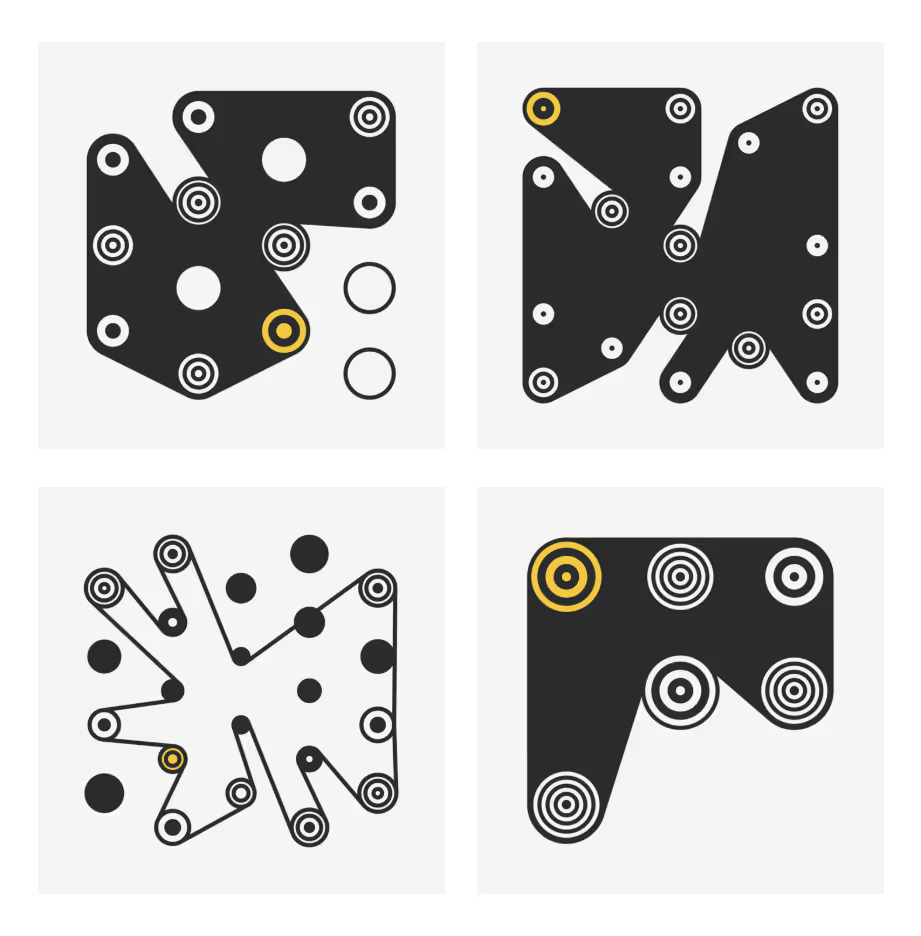
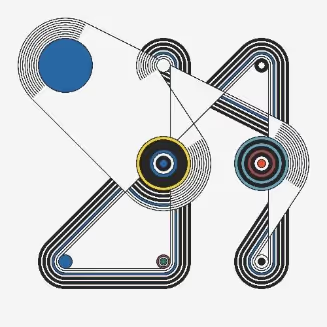
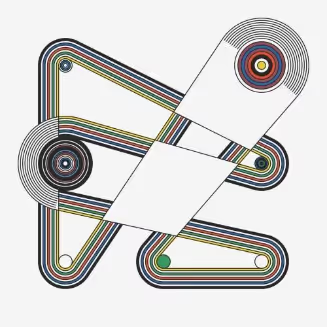
Sharing thematic elements with Ringers — such as strings, pegs, and tension through constraint — A slight lack of symmetry can cause so much pain (2021) diverges in both structure and intent. While Ringers sorts pegs around a fixed central axis to produce visually balanced forms, this series of four unique 1/1s embraces unsorted, asymmetrical arrangements, resulting in compositions that feel more varied, expressive, and improvisational.
The color distribution in the series draws from Ellsworth Kelly’s Spectrum Colors Arranged by Chance (1951–1953), grounding Cherniak’s palette in a lineage of historical abstraction and chance-based process. This approach contrasts with the limited, tightly curated palette of Ringers, offering a more chromatically open and painterly feel.
Cherniak's personal reflection adds another layer of meaning to the works, noting, “A slight lack of symmetry can cause so much pain, besides being a compositional wink, was also a reference to a flare up of scoliosis during the pandemic. The works were created, while I was lying in bed to rest my back over a few days.”
In 2023, Hivemind Digital Culture Fund acquired two of the four 1/1s from the series (Figures 11 and 12). Beyond its technological prowess, the work shows Cherniak’s range and sensitivity — balancing compositional rigor with personal reflection — and contributes to the evolving narrative of digital art as a medium of both logic and feeling.
About the Art: Light Years
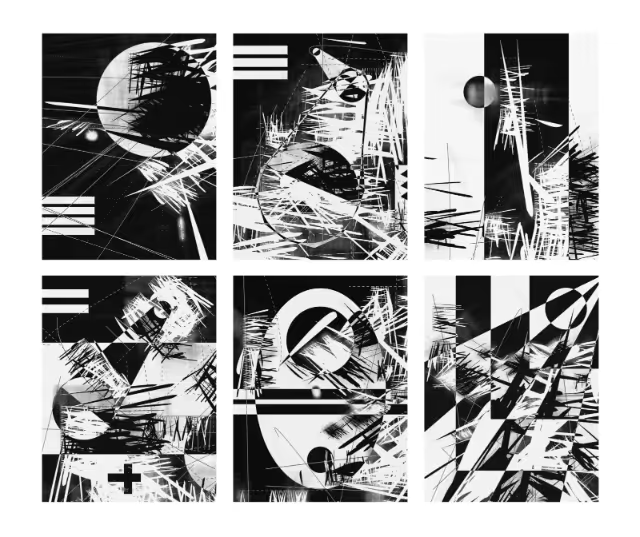
While Cherniak’s chance-based, autonomous operations are reminiscent of Dada and Surrealist art, his visual vocabulary often recalls that of Constructivism. In fact, Cherniak has explicitly cited Constructivism as an inspiration for his work, and in 2022, he released the series Light Years in collaboration with the estate of famous Constructivist artist and Bauhaus instructor László Moholy-Nagy (Figure 13). A work from Cherniak’s Light Years series is now in the permanent collection of LACMA (Figure 14).
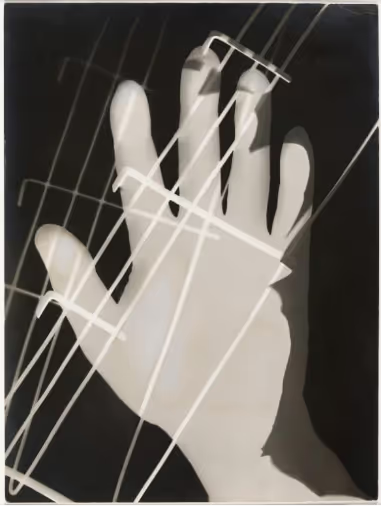
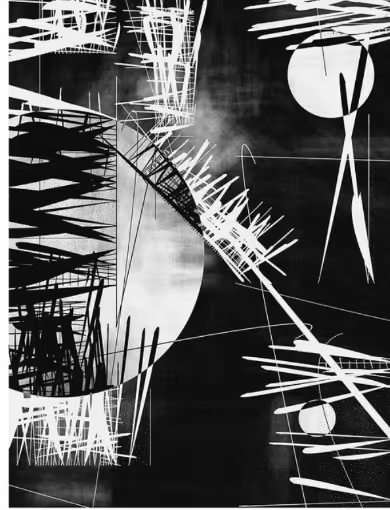
This series is one of Cherniak’s most visually and thematically interesting, paying homage to Moholy-Nagy’s pioneering exploration of photogram, an image-making technique that used photosensitized paper, exposed to light, without the need for a camera. The Light Years collection adds a digitally native twist, “partially using an autonomous system programmed by code, and partially using a hand curated and polished analog photographic development process”, Cherniak says in conversation with Darius Himes, Head of Photographs at Christie’s.
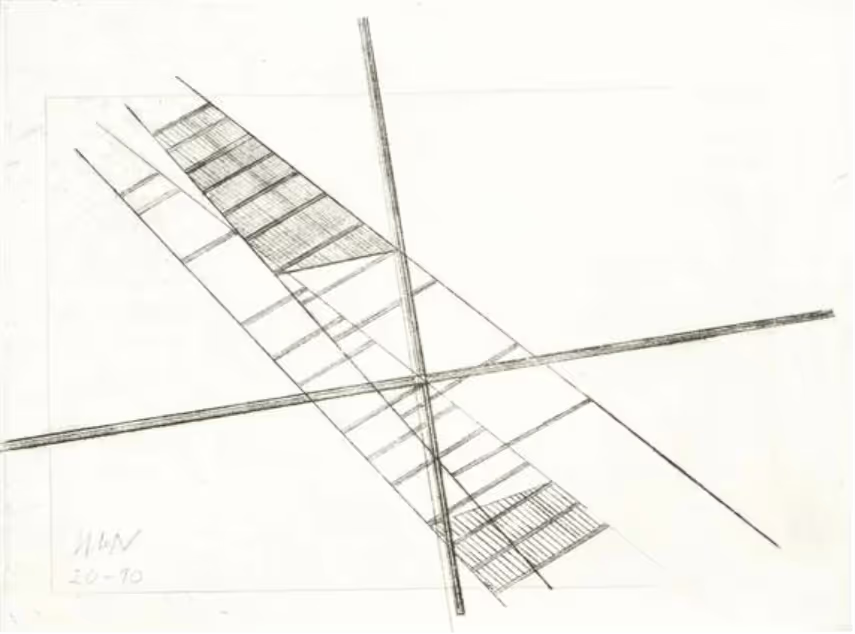
Inspired by Moholy-Nagy’s own interest in technological advancement – such as Crossing Diagonals (1925) (Figure 15) — Dmitri’s algorithm was built around train track-like segments that shift in perspective, and circular beams of light or dark.
Following Hivemind Digital Culture Fund’s acquisition of five Light Years in January 2025 (Figure 16), taking our collection up to six total, Dmitri shared: “Light Years was a very fulfilling and personal project. It was such an honor to spend time with Hattula Moholy-Nagy going through her father’s archives. Moholy-Nagy focus on using technology and cutting-edge materials for art and creative purposes instead of for political or economic levers has shaped my practice deeply.”
Sources
- Artnews - LACMA Has Acquired a Who’s Who of Blockchain Art by Important Generative Artists
- Sothebys - Dmitri Cherniak’s ‘Goose’ Lays $6.2M Golden Egg at Generative Art Auction
- NFT Now - Dmitri Cherniak’s Ringers #879, ‘The Goose,’ Just Sold for $6.2 Million
- Artnet - NFT Artist Dmitri Cherniak Is Taking Creative Cues From the Archives of László Moholy-Nagy for His New Generative Art Series
- Avant Arte - In conversation: Dmitri Cherniak at LACMA